
Inquiry & Reimagining
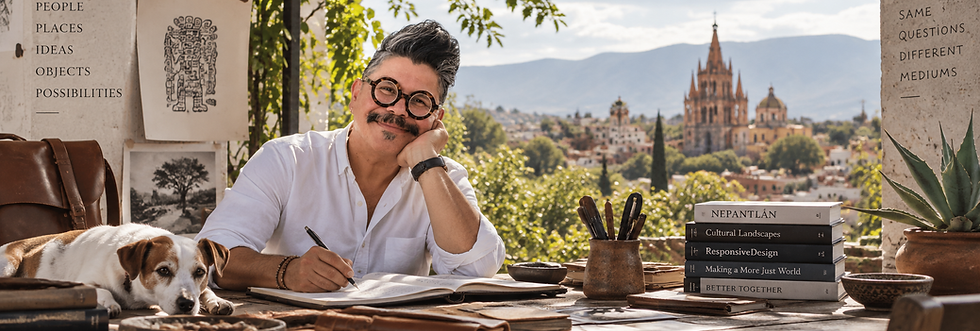
Organizations move toward strategies. Teams search for solutions. Individuals make plans. Yet the most consequential questions are rarely contained in the problem as it was first presented. They live in the patterns, assumptions, relationships, histories, and possibilities surrounding it.
My approach begins somewhere else.
With inquiry.
Grounded in ResponsiveDesign, an approach I developed through years of work across ethnography, education, design, and organizational learning, I begin by creating the conditions to look carefully at what is already there.
Not simply at what people say is happening, but at what we can notice when we become curious about the situation itself.
Notice
Inquiry begins with attention.
We slow down. We observe. We listen. We look across perspectives and examine the everyday practices, stories, objects, language, relationships, and routines through which a situation has taken shape.
Often, something important is already visible. We simply haven't learned to recognize its significance.
What are we seeing?
What aren't we seeing?
What have we stopped noticing?
Question
What we notice changes the questions we are able to ask.
Rather than accepting the original problem as given, we examine how it has been framed. We surface assumptions. We look for contradictions, tensions, absences, and unexpected connections.
Sometimes the most important outcome of inquiry is not an answer.
It is discovering that we have been asking the wrong question.
Reimagine
Once a situation can be seen differently, possibilities begin to multiply.
This is where inquiry becomes generative.
We bring together ideas that may not ordinarily encounter one another. We work across disciplines and ways of knowing. We imagine alternatives without requiring that we immediately know which one is right.
Reimagining is not prediction.
It is the disciplined practice of asking: What else might be possible?
Make
Ideas become more useful when we give them form.
A possibility might become a sketch, a conversation, a prototype, a new practice, a changed ritual, a different organizational structure, or a small experiment.
We make something we can encounter rather than continuing to discuss something abstractly.
And then we pay attention to what happens.
Learn & Revise
ResponsiveDesign is iterative because people, organizations, and cultures are not static.
We try something. We notice what it reveals. We learn from what happens. We revise our understanding—and sometimes the question itself.
Then we begin again.
There is no assumption that the first solution will be the right one. The process remains responsive to what the inquiry continues to reveal.
Responsive-Design
ResponsiveDesign grew from my work as a teacher, ethnographer, researcher, and founder of the Cultural Landscapes Collaboratory.
It brings the observational discipline of ethnography into conversation with the generative possibilities of design.
Its premise is simple:
Before we can meaningfully change something, we have to learn to see it.
That principle has traveled with me through classrooms, universities, museums, organizations, school design, creative practice, and now my work as a thinking partner.
The contexts change.
The practice remains: Notice. Question. Reimagine. Make. Learn. Revise.
And somewhere in that movement, what had been invisible often begins to appear.